[33 MIN LISTEN]
Every October, witches are everywhere.
They're in our movies, decorations, costumes, and stories. Some are frightening, others are glamorous, and plenty are simply entertaining.
But I've spent the past few years exploring witches in an entirely different way.
I've been reflecting on the concept of the witch wound and what it can reveal about women's relationships with self-expression, intuition, and the fear of being judged.
The subject has become increasingly meaningful throughout my personal growth and spiritual journey.
Because even after years of working on my confidence and learning to trust myself, I still notice moments when I'm excited to express something meaningful and immediately begin wondering how other people might react.
And that has me asking some interesting questions.
What Is the Witch Wound?
The witch wound is a concept used in contemporary spiritual and feminist communities to describe the fear and conditioning that can surround women's power, intuition, independence, and self-expression.
It draws inspiration from the historical persecution of people accused of witchcraft, most of whom were women in many parts of early modern Europe.
Today, the term is often used to explore experiences such as:
Fear of being judged or rejected for expressing yourself
Difficulty trusting your intuition or personal preferences
Feeling guilty for having needs or setting boundaries
Suppressing your opinions to avoid conflict
Feeling uncomfortable with your ambition, independence, or visibility
The witch wound isn't a clinical diagnosis or a scientifically established form of inherited trauma. It's a way of interpreting experiences that may also be influenced by family dynamics, cultural expectations, relationships, and personal history.
For me, it's been a meaningful framework for exploring why I sometimes hesitate to share parts of myself that I genuinely value.
Where Does the Witch Wound Come From?
The concept draws on the history of witch hunts, particularly those that occurred across parts of Europe during the sixteenth and seventeenth centuries.
Tens of thousands of people were executed after being accused of witchcraft.
Most of those convicted were women, although men were accused as well.
The causes were complex, involving religious beliefs, superstition, community conflicts, social tensions, and the legal practices of the time.
It's historically inaccurate to suggest that every accused witch was a healer or that all witch trials were part of a single organized campaign against powerful women.
Nevertheless, misogynistic beliefs influenced important aspects of witchcraft persecution, including portrayals of women as especially vulnerable to evil or dangerous when they departed from accepted expectations.
And the broader history of women's restricted autonomy extends far beyond the witch trials themselves.
For centuries, women in many societies faced legal and social limitations on their education, property rights, political participation, sexuality, and independence.
That history provides context for contemporary conversations about women's self-expression, even though it doesn't prove that any particular modern behavior was inherited from the witch trials.
What Does It Mean to Reclaim Your Inner Witch?
The word witch has different meanings across cultures, religions, and spiritual traditions.
But some contemporary writers and thinkers have reclaimed it as a symbol of feminine autonomy, intuition, connection to nature, and self-determination.
Lisa Lister explores reclaiming the witch in her book Witch.
Clarissa Pinkola Estés examines women's instinctual nature through mythology and storytelling in Women Who Run With the Wolves.
And Ellen Vora's Season of the Witch invites readers to reconsider intuition, embodiment, and the role of mystery in their lives.
Their approaches differ, but each has contributed to a broader conversation about how women relate to their inner lives.
For me, reclaiming my inner witch means developing a relationship with myself grounded in self-trust and self-love.
It means paying attention to what my body is communicating, respecting my needs, and becoming more comfortable making decisions that reflect who I am.
It also means allowing myself to explore interests and beliefs without feeling obligated to explain them to everyone.
You don't have to practice witchcraft or identify as spiritual to connect with those ideas.
How the Witch Wound Can Show Up in Everyday Life
One of the reasons this subject resonates with me is that I recognize some of these patterns in my own life.
I've spent years working through perfectionism, people-pleasing, and the fear of being misunderstood.
I know what it's like to replay conversations, worry about other people's opinions, and hesitate before expressing something that matters to me.
As my interest in spirituality, manifestation, consciousness, and energy work has grown, I've noticed an interesting tension.
I feel increasingly comfortable exploring those subjects privately.
But sharing what I'm learning can still feel vulnerable.
Sometimes I'll have an experience that feels meaningful, and I'll be eager to talk about it.
Then I wonder whether someone will understand or whether they'll judge me for being interested in it.
That hesitation has made me curious about the difference between knowing myself and feeling comfortable allowing other people to see me.
Of course, fear of judgment can develop for many reasons, and the witch wound isn't a complete explanation for those experiences.
But the framework has helped me notice patterns that I might otherwise overlook.
The Difference Between Protecting What's Sacred and Hiding Who You Are
This has become one of the most interesting parts of my own exploration.
Sometimes I hesitate to share something because I'm afraid of being judged.
Other times, I keep an experience private because it feels deeply personal.
And those motivations aren't necessarily the same.
When something feels sacred to you, sharing it can invite opinions, questions, or interpretations you weren't looking for.
You might genuinely want to hold an experience close while you're still exploring what it means.
I've realized that becoming more confident doesn't require me to share every belief, thought, or experience publicly.
Self-trust also involves deciding what I want to keep private.
The question I'm learning to ask is whether I'm making that decision intentionally or automatically allowing fear to make it for me.
Sometimes the answer is a little of both.
And that's worth exploring with curiosity rather than criticism.
The Sister Wound: Why Relationships With Other Women Matter
A related concept is the sister wound.
This term is often used to explore experiences of competition, comparison, exclusion, betrayal, and judgment within relationships between women.
It's another contemporary framework, rather than a clinical diagnosis.
This aspect of the conversation has been especially meaningful to me because some of my earliest experiences with judgment and rejection happened within female friendships.
I've spent time reflecting on how those experiences influenced my sense of belonging and my willingness to be fully myself around other women.
Even recurring dreams involving friendships from earlier seasons of my life have encouraged me to revisit feelings I thought I'd moved beyond.
I don't view those dreams as proof of a particular spiritual explanation. But I've found it useful to pay attention to the emotions they bring up.
Experiences of exclusion or comparison can affect how we approach new friendships, how comfortable we feel celebrating ourselves, and whether we trust that other women will accept us.
And those patterns can change.
We can become more aware of our expectations, work through painful experiences, and build friendships grounded in mutual respect and genuine support.
How to Begin Healing the Witch Wound
You don't have to make a dramatic change to begin exploring your relationship with self-trust.
In fact, I think the smallest moments are often the most revealing.
Notice when you're overriding yourself
Pay attention to the times you agree to something you don't want to do, apologize unnecessarily, or dismiss an opinion because you're worried about how someone might respond.
You don't need to immediately change your behavior.
Begin by noticing it.
Get curious about your body's signals
When something feels uncomfortable, exciting, overwhelming, or meaningful, give yourself a moment to recognize that experience. Your feelings can offer valuable information, although they aren't always reliable instructions. Curiosity allows you to explore what you're experiencing without immediately acting on it.
Practice small acts of self-trust
Maybe you express a preference without apologizing.
Maybe you set a boundary that respects your energy.
Maybe you explore an interest you've been curious about without asking whether anyone else thinks it's worthwhile.
Each experience gives you an opportunity to learn more about yourself.
Reconsider your relationship with other women's opinions
If you've experienced painful friendships or rejection, notice whether you're anticipating those same experiences in your current relationships. Give yourself room to develop new expectations and connect with women who respect your individuality.
Decide what you want to share
You don't owe anyone an explanation of your spiritual practices, personal experiences, or private beliefs. You can share when you want connection and choose privacy when something feels precious.Both can be expressions of self-trust.
Reclaiming Your Power Doesn't Require Reinventing Your Life
I don't believe healing has to involve uprooting your life or becoming someone entirely different.
For me, this journey has been about becoming more comfortable with who I already am.
I'm learning to trust my voice, explore what interests me, and recognize when fear of judgment is influencing my decisions.
And I'm still learning.
If the idea of the witch wound resonates with you, perhaps begin by asking yourself where you feel most hesitant to express your needs, preferences, or beliefs.
Notice what happens when you give those parts of yourself a little more attention.
You may discover that rebuilding your confidence begins with something as simple as listening to yourself.
And allowing what you hear to matter.
Learn more in episode 112 of the Life with Liz Podcast below.
Further reading: Witch by Lisa Lister; Women Who Run With the Wolves by Clarissa Pinkola Estés; Season of the Witch by Ellen Vora, MD.
Episode transcript:
This is an auto-generated, unedited episode transcript. Please excuse any tyops.
Welcome to The Life with Liz Podcast, the place to be if you wanna go from invisible to vibrant in your life and embrace the power you didn't know you had inside of you. I'm your host, Liz Fleming, business owner, mom, military spouse, entrepreneur, founder, CEO, and life coach, who is passionate about helping ambitious women like you step into their power and their purpose on purpose so they can experience as much joy, success, satisfaction, and abundance as humanly possible. Now without further ado, let's dive right into this episode.
INTRO | THE WITCH WOUND There's something I've been exploring for the past few years that has completely changed the way I understand certain patterns in my life. And with Halloween just around the corner, I thought this would be a fitting time to bring it to the podcast. We're talking about the witch wound. Now, before you start picturing pointy hats, broomsticks, and bubbling cauldrons, I promise we're going somewhere a little deeper with this. Because the witch wound is a concept that has helped me explore some of the fears I've carried for much of my life, particularly the fear of being judged, misunderstood, rejected, or simply being too much for other people. And what's fascinating is how those fears can continue showing up even when you've spent years working on your confidence and learning to trust yourself. I've experienced this throughout my relationships with other women, in my tendency to avoid confrontation, and even now, as my spirituality has become an increasingly meaningful part of my life. There are things I've learned and experienced that I'm genuinely excited to talk about. Sometimes I feel like I could spend hours discussing them. But every so often, I catch myself hesitating. I wonder how someone might interpret what I'm saying. Whether they'll understand where I'm coming from. Whether expressing that part of myself will change how they see me. And that has led me to explore a question I think many women can relate to. Why can it feel so uncomfortable, and sometimes even frightening, to allow ourselves to be fully seen? Today, we're going to explore the history behind the witch wound, how it can show up in our everyday lives, and what reclaiming our inner witch might actually look like. We'll also touch on the sister wound and the ways our experiences with other women can influence our sense of belonging and safety. And ultimately, I want to talk about what it means to develop such a trusting relationship with yourself that you're no longer making so many of your decisions around the possibility of someone else's judgment. PART ONE | WHAT IS THE WITCH WOUND? Let's start with what the witch wound actually is, because there's a fascinating history behind it, and I want to be thoughtful about how we talk about that history. The witch wound is a term used in modern spiritual and feminist conversations to explore the fear, shame, and conditioning associated with women's power, intuition, independence, and self-expression. The idea is that, throughout history, women have faced consequences for stepping outside the roles society expected them to play. And those expectations have influenced the way women learn to navigate the world, including how comfortable we feel speaking up, expressing ourselves, and trusting our own judgment. Now, an important distinction here: the witch wound isn't a clinical diagnosis, and we don't have scientific evidence that every woman carries inherited trauma specifically from the witch trials. It's a framework for exploring experiences that many of us recognize, and it draws on some very real historical events. During the European witch hunts, particularly in the sixteenth and seventeenth centuries, tens of thousands of people were executed after being accused of witchcraft. And the majority of those people were women. Can you imagine living in a time when an accusation from someone in your community could put your entire life at risk? The history is complicated, of course. Religion, superstition, local conflicts, political tensions, and the legal systems of the time all played a role. Men were accused, too, and women sometimes accused other women. So it would be inaccurate to say that every person persecuted for witchcraft was secretly a healer or that the witch trials were one enormous, coordinated effort to eliminate powerful women. But misogyny was absolutely part of the historical picture. Women were often portrayed as morally weaker, more susceptible to evil, or especially dangerous when they challenged accepted expectations. And when you consider the broader history of women's rights, the restrictions on our education, property ownership, political participation, independence, and control over our own bodies, you begin to see how deeply women's autonomy has been regulated throughout history. Now, I'm certainly not comparing the fear of being judged on social media with the experiences of women who were persecuted centuries ago. But I am interested in the expectations that have shaped women's lives over generations. Because even today, women can be criticized for being too ambitious, too emotional, too outspoken, too independent, too sexual, or simply unwilling to behave the way someone else expects them to. And somewhere along the way, many of us learn that being accepted means being careful about how much of ourselves we reveal. That's the part of this conversation that really resonates with me. PART TWO | SO WHAT IS A WITCH, REALLY? Okay, so let's talk about witches. Because depending on your childhood and how many Halloween movies you've watched, you might have a pretty specific picture in your head. It could be the frightening old woman living alone in the woods, the green-faced villain with a crooked nose, or the mysterious woman casting spells and causing trouble. And listen, I love a good witchy movie. We're not coming for Hocus Pocus today. But the history of witchcraft is much more complicated than what we've seen on screen. Different cultures and spiritual traditions have understood witchcraft in different ways. Some practices involve ritual, folk traditions, healing, relationships with nature, or spiritual beliefs. And many of the people historically accused of witchcraft wouldn't have identified as witches at all. So there's no single definition that captures every tradition or experience. But something interesting has happened in modern feminist and spiritual communities. Women have begun reclaiming the word witch as a symbol of independence, intuition, and feminine power. And I LOVE this interpretation. Because when I think about reclaiming my inner witch, I picture a woman who has developed a deep relationship with herself. She knows how to listen to her body. She's curious about the world and comfortable questioning things. She respects her own needs and doesn't feel obligated to shape her entire life around other people's expectations. She might be deeply spiritual, work with energy, practice rituals, or feel connected to nature. Or she could be a woman who has finally learned how to say no without writing a three-paragraph apology afterward. Which, let's be real, can feel like its own form of magic. And you don't have to identify as a witch or practice any particular form of spirituality to appreciate that symbolism. I've been inspired by writers like Lisa Lister, who explores reclaiming the witch as a symbol of feminine power, and Clarissa Pinkola Estés, whose work in Women Who Run With the Wolves examines women's instinctual nature through mythology and storytelling. Dr. Ellen Vora also explores intuition, embodiment, and our relationship with mystery in her work. These writers approach their subjects from different perspectives, and I appreciate that. I don't need every author I read to agree on everything. What interests me is how their work invites women to question the expectations we've internalized and become more curious about our own experiences. Because what would happen if we stopped treating every unfamiliar part of ourselves as something we needed to explain, justify, or fix? PART THREE | THE WOUND I RECOGNIZED IN MYSELF I first encountered the concept of the witch wound a couple of years ago, and it resonated almost immediately. Not because I suddenly remembered a past life as a woman being chased through the woods. Although, given some of the dreams I have, who knows what my brain will come up with next. But seriously, I recognized so much of my own experience in the fear of being judged. If you've listened to this podcast for a while, you know I've spent years exploring perfectionism, people-pleasing, and the ways I've looked outside myself for approval and reassurance. For much of my life, I was so concerned with being liked and accepted that I would question my own reactions before I questioned what was happening around me. I could replay a conversation over and over, wondering whether I'd said something wrong or whether somebody had interpreted my words differently than I intended. And when I look back at my experiences with female friendships, particularly when I was younger, I can see how some of those patterns developed. There were friendships that felt complicated, moments of exclusion or judgment, and experiences that made me especially sensitive to how other people perceived me. I learned to pay attention to the room. To notice people's reactions. To wonder whether I was doing something that might cause somebody to pull away. And those habits can become so familiar that you don't even realize you're doing them. What's especially interesting to me is that some of those relationships and experiences still show up in my dreams. I've had recurring dreams involving people from different seasons of my life, particularly my school years. And sometimes I'll wake up wondering why those people are still making appearances in my subconscious after all this time. Like, hello? We graduated a LONG time ago. But I've become curious about the emotions those dreams bring up. I don't assume every dream has some extraordinary spiritual meaning. Our minds process memories and feelings in all kinds of ways. Still, when I notice the same feelings of rejection, uncertainty, or wanting to belong, it gives me something to reflect on. And through that reflection, I've recognized how much of my life I spent trying to be the version of myself I thought other people would find easiest to accept. That was exhausting. Because you're constantly adjusting yourself according to reactions you can't even control. And when you've lived that way for a long time, learning to trust yourself can feel surprisingly uncomfortable. You might consciously understand that you don't need everyone's approval, but actually behaving that way takes practice. Which brings me to the part of this conversation that feels especially relevant to where I am today. PART FOUR | WHEN YOUR INNER WORLD CHANGES BEFORE YOUR OUTER WORLD DOES Over the past several years, my spiritual journey has opened up an entirely new world of curiosity for me. I've become fascinated by manifestation, consciousness, intuition, energy work, and the many ways people understand their relationship with the world around them. I love exploring these ideas. I love asking questions and discovering perspectives I hadn't considered before. And as I've become more comfortable with my spirituality, something interesting has happened. I feel increasingly confident in my relationship with myself, but I'm still figuring out how comfortable I am expressing that part of myself to other people. Sometimes I'll have an experience or realization that feels incredibly meaningful, and my immediate reaction is, WHOAAAA. I need to talk about this! I'm excited. I'm curious. I want to have one of those conversations where you completely lose track of time because you're so fascinated by the subject. But then I'll hesitate. I'll start thinking about how to explain it or whether the person listening would understand where I'm coming from. And sometimes I worry that what feels meaningful to me might sound completely ridiculous to somebody else. Which is kind of funny when you consider how much time I've spent teaching and writing about self-trust. Apparently, knowing something intellectually and practicing it in every area of your life are two very different experiences. But I've been exploring why that hesitation still shows up. Because it's not always that I'm questioning my own interests or experiences. Sometimes I know exactly what I want to talk about. I'm just nervous about how it might be received. And I imagine there are women listening who can relate to that, even if spirituality isn't your thing. You could be developing a new interest that the people around you don't understand, changing your mind about something important, or beginning to question expectations you've lived with for years. You can feel genuinely excited about your growth while also feeling uncertain about how it fits into your existing relationships. And there's a loneliness that can accompany that. You don't want to force your perspective on anyone else. You respect that people have different beliefs and experiences. But you also want room to explore the things that are meaningful to you. I've found myself navigating that balance quite a bit lately. And the more I reflect on it, the more I realize that being comfortable with myself doesn't necessarily mean everybody else is going to understand me. I'm learning to become more comfortable with that possibility. PART FIVE | PROTECTING WHAT'S SACRED OR HIDING WHO YOU ARE? There's another dimension to this that I've been thinking about recently, and it's become one of my favorite parts of this entire conversation. Sometimes I hold back because I'm afraid of being judged. But sometimes I hold back because something feels sacred to me. And those are two very different motivations. There are experiences and realizations that feel incredibly personal. You might have had a moment in nature that moved you, a spiritual experience that brought you comfort, or a realization that shifted the way you see your life. And sometimes, before you've even figured out what that experience means to you, there's this impulse to share it. Especially now, when sharing has become such a normal part of our lives. But the moment you share something, you invite other people's interpretations into it. They might ask questions you weren't prepared to answer. They might not find it particularly interesting. Or they might have an entirely different explanation for what happened. And that's okay. People are allowed to see things differently. But I've realized that sometimes I want to enjoy an experience without immediately having to explain it. I want to let it be meaningful to me. And this has challenged something I used to believe about confidence. I used to assume that becoming more confident meant I would eventually feel comfortable sharing absolutely everything. That if I was truly secure in myself, I wouldn't hesitate to express any belief, opinion, or experience. But I'm not so sure that's the goal anymore. Because self-trust also means trusting myself to decide what I want to share. I can have a rich spiritual life without turning every experience into a public conversation. I can be genuinely excited about something and still choose to hold it close. And I can share when I want to connect, rather than feeling like I need to prove how brave or authentic I am. So now, when I notice myself hesitating, I try to get curious about why. Am I holding back because I'm afraid of being judged? Or am I choosing privacy because this experience feels precious to me? Sometimes the answer is both. And I don't need to criticize myself for that. I can take my time, decide what feels right, and trust myself to know the difference. To me, that's a beautiful expression of reclaiming your power. PART SIX | THE SISTER WOUND There's another concept closely related to the witch wound that I want to touch on, and that's the sister wound. This is a term used in some spiritual and personal growth conversations to explore the effects of competition, comparison, exclusion, betrayal, and judgment within relationships between women. Like the witch wound, it isn't a clinical diagnosis. It's a way of examining experiences and patterns that can influence how we relate to one another. And this one has been particularly meaningful for me because some of my earliest experiences of feeling judged or rejected happened within female friendships. I imagine many of you can relate. Think back to being excluded from a group of girls when you were younger, or having a friendship end in a way that left you questioning yourself. Or experiencing competition or comparison within a friendship and wondering whether it was safe to celebrate your own success. Those experiences can stay with us. And sometimes, without realizing it, we begin anticipating the same reactions in new relationships. We might be more guarded than we want to be, or feel uncomfortable allowing other women to see us fully. Of course, I don't want to suggest that every difficult friendship is evidence of some enormous historical wound. Relationships are complicated, and sometimes people hurt one another because they're insecure, immature, or simply don't know how to navigate conflict. But I do find it interesting to consider how women have been encouraged to compare themselves with one another and compete for approval, attention, and acceptance. And what that can do to our relationships. Because I've experienced the beauty of women supporting one another, too. Women who celebrate each other's success, who are genuinely curious about one another's lives, and who can hold different perspectives without turning those differences into a competition. Those relationships feel very different. Part of my own growth has involved recognizing that another woman's opinion doesn't have to determine how I feel about myself. I can appreciate somebody else's path without questioning my own. And I can build relationships with women who allow me to be myself, just as I want to offer that same acceptance to them. PART SEVEN | HOW THE WITCH WOUND SHOWS UP IN EVERYDAY LIFE Now, you might be listening to all of this thinking, okay, this is interesting, but I'm not particularly spiritual, and I've never thought of myself as a witch. What does any of this have to do with me? Well, you don't have to identify with the word witch to recognize some of the experiences we've been discussing. Think about how often women apologize for things that don't actually require an apology. Or how easily we can talk ourselves into saying yes when we'd really prefer to say no. You've probably had an opinion during a conversation but decided it would be easier to keep it to yourself. Or wanted to try something new, pursue a creative interest, or make a change in your life, but before you've even given yourself a chance to explore it, you're already imagining what other people might think. I can relate to all of that. I've had moments when I've felt the need to justify my ambition or explain why I want to keep creating, learning, and exploring new possibilities. As though wanting a life that feels meaningful and fulfilling requires everybody else's permission. And the funny thing is, sometimes nobody has even said anything! We're anticipating reactions that haven't happened. We're having entire imaginary conversations with people who aren't even in the room. And then we make decisions based on those imaginary conversations. I've certainly done my fair share of that. Now, fear of judgment and people-pleasing can develop for many reasons. Our upbringing, relationships, cultural expectations, and individual experiences all play a role. The witch wound isn't an explanation for every uncomfortable feeling or every moment of self-doubt. But as a framework, it can encourage us to ask a useful question: Have I learned to associate being fully myself with the possibility of losing acceptance? That's a question that has helped me understand some of my own patterns. And the more aware I become of those patterns, the more opportunities I have to make different choices. PART EIGHT | RECLAIMING YOUR INNER WITCH So, how do we begin healing the witch wound? Or perhaps more accurately, how do we begin changing the patterns we've recognized in ourselves? For me, reclaiming my inner witch comes down to developing a deep relationship with self-trust and self-love. I want to feel comfortable enough with myself that I can listen to my own needs, explore my interests, and make decisions without automatically looking for someone else's approval. And a big part of that is learning to listen to my body. Noticing when I'm tired or overwhelmed, when something feels exciting, or when I'm uncomfortable and need to explore why. Our bodies communicate so much information through physical sensations, emotions, and responses to our environment. That doesn't mean every feeling is an instruction we need to follow. Sometimes anxiety makes a perfectly safe situation feel threatening, and sometimes excitement can lead us toward something that isn't actually a great idea. But those experiences deserve our attention. We can become curious about what we're feeling instead of immediately dismissing it. And I love that this work can begin in such ordinary moments. You don't have to move into the woods, buy a cauldron, and announce that you've officially entered your witch era. Although if that's your dream, who am I to stand in your way? You can begin by noticing how often you override yourself. The next time you're about to apologize, stop for a moment and ask whether you've actually done something wrong. When somebody asks you to do something, give yourself a little time to consider whether you genuinely want to say yes. If you feel drawn to a new interest, explore it without immediately asking what everyone else thinks. And if you've been hesitant to express an opinion, practice in small, manageable ways with people you trust. The goal isn't to force yourself into uncomfortable situations to prove you're brave. It's to build confidence in your ability to recognize what matters to you and respond in ways that feel aligned with your values. And that takes practice. Especially if you've spent years prioritizing other people's expectations. I also want to emphasize that you don't have to adopt any particular spiritual belief to do this work. Your version of reconnecting with yourself could involve meditation, journaling, spending time in nature, or exploring your intuition. It could be learning to set boundaries, making time for your creativity, or having a conversation you've been avoiding. Or simply giving yourself permission to be curious about a part of yourself you've never really explored. There are so many ways to develop a deeper relationship with yourself. And I don't believe you have to completely reinvent your life to begin. Sometimes the smallest changes are the ones that reveal the most. You start noticing how you feel. You recognize the moments when fear is influencing your decisions. You experiment with making a different choice. And gradually, you become more familiar with your own voice. For me, that's where the magic is. CLOSING | YOUR MAGIC IS YOURS The more I've explored the witch wound, the more I've recognized how much of my personal growth journey has involved becoming comfortable with who I am. I've spent years working through old experiences, questioning patterns, and learning to develop a relationship with my intuition that feels authentic to me. And I'm still learning. There are still moments when I hesitate to speak up or wonder what somebody might think. There are parts of my spiritual journey that I'm still figuring out how, or whether, I want to share. But I also recognize how much has changed. I'm becoming more comfortable exploring what feels meaningful to me, even when I know other people may see things differently. And I no longer want to make so many of my decisions around the possibility of being misunderstood. We don't all have to believe the same things or experience the world in the same way. What matters to me is that I can continue learning, growing, and expressing myself without constantly abandoning my own needs in the process. And that's what I'd love for you to take away from today's conversation. You don't have to do anything drastic. Begin by noticing the moments when you hesitate to express a preference, dismiss a feeling, or talk yourself out of something you're excited about. Get curious about what's happening. Ask yourself whether you're making a decision because it genuinely feels right for you or because you're worried about how somebody else might respond. And see what happens when you give your own voice a little more attention. You might decide to share something you've been keeping to yourself. Or realize that something feels sacred and you'd prefer to hold it close. Both can be meaningful choices when they're made with awareness and self-trust. Because reclaiming your inner witch, at least the way I understand it, is about becoming more comfortable with the person you already are. And I hope this conversation encourages you to explore that relationship with yourself. I'd also love to hear what you think about this subject, especially if the witch wound is something you've explored in your own life. Have you heard of it before? Does any of this resonate with you? And what does reclaiming your own power mean to you? Send me a message or reach out through my website. I'm genuinely curious to hear your perspective. I'll leave a few books and resources in the show notes if you'd like to explore the subject further, including work by Lisa Lister, Clarissa Pinkola Estés, and Ellen Vora. And if you'd like to go deeper into the self-trust and personal growth work we discuss here, you can also find my free training linked below. Thank you so much for spending this time with me. Happy Halloween, my friends. I'll see you in the next episode.
Did that go by too fast? No worries. You can always find me over at elisabethfleming.com for more information about my programs, events, and how you can take your learning further with me. If you loved this episode, leave a review. It helps more than you know.
Thank you so much for tuning in. I'll catch you next time.
WANT TO GO A LITTLE DEEPER?
If something in this post brought something up for you, I’ve opened a small number of private coaching spots for the remainder of the year. I offer focused 60-minute Power Sessions and a three-session Intensive for women who want personalized support with whatever they’re navigating, working toward, or ready to understand more deeply.
You can learn more about private coaching and see what feels like the right fit for you here.
Connect with Liz:
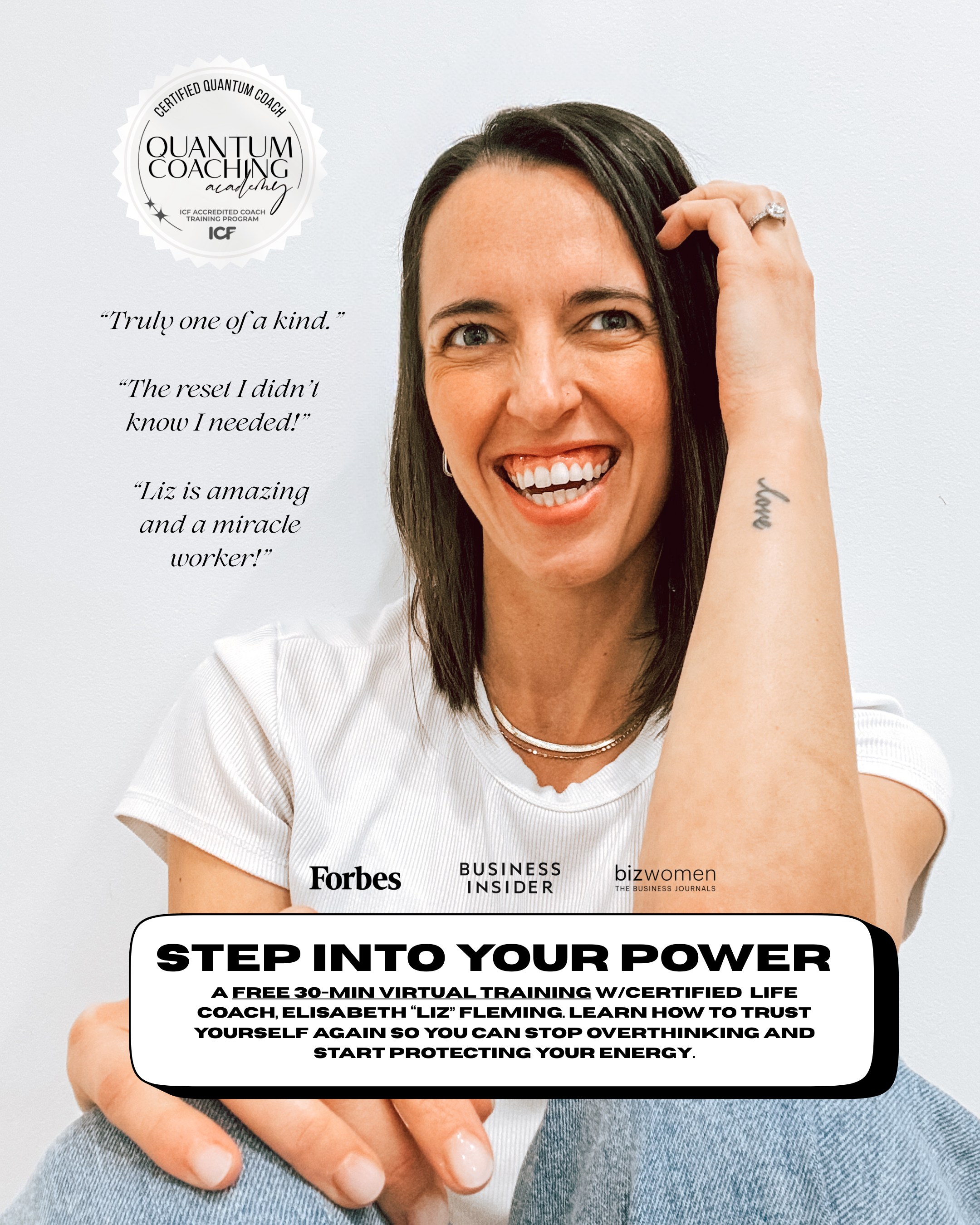
Watch Liz's FREE Workshop, Step Into Your Power:
Learn how to trust yourself again so you can stop overthinking and start protecting your energy. Watch now at elisabethfleming.com/free-workshop
Read Liz's Book:
Discover Liz’s bestselling book, Powerhouse: 3 Steps to Thrive as the Incredible Woman You Already Are — A Framework for Self-Love and Expansion: elisabethfleming.com/book
Resources:
Website: elisabethfleming.com/welcome
Instagram: @elisabeth.fleming
Podcast: The Life with Liz Podcast
If you loved this episode, rate and review it to help reach the women who need it most!
STEP INTO YOUR POWER
DISCLAIMER
The content and material presented on this podcast is for informational and educational purposes only. It shall not be construed as medical advice. The information and education provided are not intended or implied to supplement or replace professional medical treatment, advice, and/or diagnosis. The creator of this content does not dispense medical advice or prescribe the use of any technique as a form of treatment for physical, emotional, or medical problems without the advice of a physician, either directly or indirectly. The intent of the creator is only to offer experiential information to help the reader in his/her/their quest for emotional, physical, and spiritual well-being. In the event you apply any of the information provided from this content for yourself, the creator assumes no responsibility for your actions. Note: This post may include affiliate links! I may earn a small commission at no additional cost to you if you decide to click, sign up, or make a purchase.
