[35 MIN LISTEN]
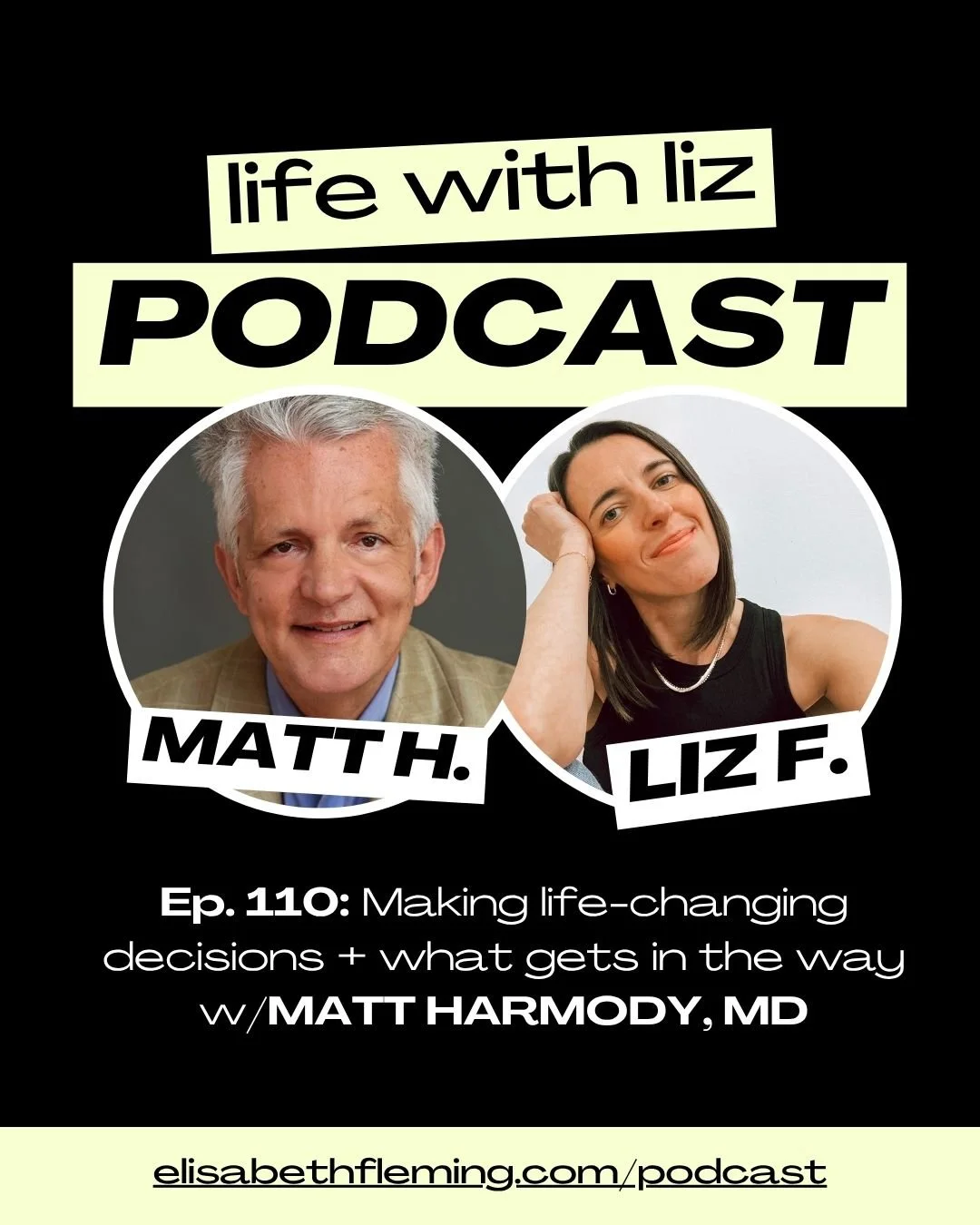
I sat down with Dr. Matt Harmody, retired emergency physician, living kidney donor, endurance athlete, and advocate, to talk about what actually happens between knowing something and acting on it.
Matt’s story is powerful. After watching his father battle kidney failure, he made the life-changing decision to pivot his entire career and donate a kidney to a stranger through the National Kidney Registry’s paired-exchange program.
But this conversation isn’t about the medical side of that decision.
It’s about what it takes to make a decision like that in the first place.
Because at its core, this is a conversation about fear, hesitation, and what gets in the way when you already know.
In this episode, you’ll hear:
• What it really feels like to “know” something before you can explain it
• Why clarity doesn’t always lead to action
• The role fear and responsibility play in big decisions
• What keeps people stuck even when the answer feels obvious
• How Matt moved from awareness → action
• Why action often creates clarity (not the other way around)
• The emotional weight behind life-altering choices
• What self-trust actually looks like in real time
• The advice Matt would give his younger self before making that decision
• What anyone sitting in hesitation needs to hear right now
The space between knowing and doing
One of the most powerful parts of this conversation is what Matt shares about the time before he made his decision.
That space where something feels clear internally… but action hasn’t happened yet.
It’s easy to assume that once you know, the next step is obvious.
But for most people, that’s where the real struggle begins.
Because knowing brings up everything else:
• fear
• responsibility
• doubt
• the weight of what could change
And instead of moving forward, many people stay in that space longer than they expected.
Not because they lack direction.
Because they don’t fully trust themselves to act on it.
Why fear doesn’t mean stopping
Matt’s story makes something very clear: fear wasn’t the absence of direction or clarity, it was part of the process.
There wasn’t a moment when everything suddenly felt easy or certain.
There was a moment when he chose to move forward with the uncertainty.
And that distinction matters.
Because so often, people wait for fear to disappear before they act.
In reality, action often happens while fear is still present.
What actually creates the shift
One of the biggest takeaways from this conversation is how the shift from thinking to doing actually happens.
It’s not always a dramatic moment or a lightning bolt of certainty.
Sometimes, it’s a quiet decision.
A willingness to move forward without having every answer.
And in many cases, clarity doesn’t come before action.
It comes because of it.
The role of self-trust
This conversation reinforces something I talk about often:
People don’t lack answers.
They lack trust in themselves to follow through on what they already know.
Matt didn’t need more information.
He needed to trust what he was already feeling.
And that’s where so many people get stuck.
Not in confusion.
In hesitation.
If you’re sitting in that space right now
If you’ve been in a place where something feels clear… but you haven’t acted yet…
This conversation will meet you there.
Not by pushing you to make a drastic decision.
But by helping you understand what’s actually happening underneath that hesitation.
Because the goal isn’t to rush the decision, it’s to understand what it takes to move when the moment comes.
Episode transcript:
This is an auto-generated, unedited episode transcript. Please excuse any tyops.
Welcome to The Life with Liz Podcast, the place to be if you wanna go from invisible to vibrant in your life and embrace the power you didn't know you had inside of you. I'm your host, Liz Fleming, business owner, mom, military spouse, entrepreneur, founder, CEO, and life coach, who is passionate about helping ambitious women like you step into their power and their purpose on purpose so they can experience as much joy, success, satisfaction, and abundance as humanly possible. Now without further ado, let's dive right into this episode.
Alrighty, Matt Harmody is here with us on the Life with Liz podcast today. Matt, welcome! Thank you so much for being here.
Matthew Harmody: It’s great to be here, Liz, thank you.
Liz Fleming: Yeah, this is a really special episode, everyone. Matt and I have the gift of living in the same town, and we got to meet because we were both authors. We were at an author event a few weeks ago at our local library, and we just got to talking about what we’re passionate about.
Matt has a really special story, and I think it’s one that you’re really gonna wanna hear.
Today’s episode is all about making life-changing decisions, and what you feel sometimes gets in the way of that. So, Matt, to start, why don’t we just talk a little bit about who you are and what you do?
Matthew Harmody: Yes, excellent, thank you for that.
So I grew up in Cleveland, have an engineering degree, and through the experiences of my father’s illness, which we certainly will talk about, I went back to medical school at age 30.
And decided to go into emergency medicine for a variety of reasons.
And that brought me here to North Carolina.
And I’ve practiced for about 25 years in emergency medicine around the surrounding counties here in the Pinehurst area, and retired a few years ago, primarily to do kidney donation advocacy work.
And that has led to some great experiences, such as climbing Mount Kilimanjaro with about 20 other living kidney donors, and then taking a trip around the country climbing the highest point in each of the 50 states with 4 other living kidney donors to attempt to set a Guinness World Record for that feat.
And that resulted in writing a book about that whole experience.
So here we are, and happy to go into more detail about any of those aspects, Liz.
Liz Fleming: Yeah, absolutely. Thank you for sharing that.
And his book is called Ascending America, so everyone should go check it out. It’s in the show notes. It’s a beautiful read. I’m working my way through it. It is just so incredible what you all did to raise awareness for this work.
But what I want to have you unpack more for us is that moment with your dad, if you’re willing to share, that initial moment where you had to make that life-changing decision. Your dad was in a position where he needed a kidney, and you were like, hey, I think that’s gonna be me.
And what I’m getting at here, too, is this decision that you made started this snowball effect of additional life-changing decisions. I mean, if you look at where you are now with the book.
So, I would love to hear a bit more about what you felt going into that. That is just a massive, massive moment in your life.
Matthew Harmody: Yeah, so I guess there’s probably four major turning points or decision points along my life that you’re alluding to.
And the first is an unforgettable call from my mother. I’m a sophomore engineering student away at school. Final exam week, midway through, I get an unexpected call from my mother.
And she’s dragged my father into the Cleveland Clinic because he was extremely ill.
And if you knew my father, that was no small feat, getting him to do something that I’m sure he did not want to do. They discovered that his kidneys had completely failed, and he was put on what’s called dialysis emergently to save his life.
And he then spent the next 9 years or so on dialysis.
And if folks aren’t familiar with it, it saves your life, but it just destroys your quality of life, so there was a gradual decline in his health. He was a very active outdoorsman, and those things gradually disappeared from his ability to do those things.
So, he decided to withdraw care. This first happened at age 50, and after withdrawing care from dialysis, he passed away at 59.
And I worked as an engineering expert in the oil industry, and that whole experience led me to go back to medical school at age 30.
He unfortunately didn’t want to consider a living kidney donation from a family member, and I would have been on the short list for that. That always stuck with me as a missed opportunity to help my father, for all that my parents provided me growing up.
I proceeded to work in emergency medicine and see dialysis patients every day, each of them reminding me of my father and what he went through.
So the first big transition was going back to medical school at age 30. Not an easy feat, especially to leave a comfortable career.
Then the second big decision was deciding to donate a kidney to a stranger back in 2017.
And now with a little bit more wisdom and experience, my father’s decision, I used to think it was somewhat selfish on his part, and he didn’t fully consider it, but now I realize that it was selfless, and that it gave me an opportunity to save someone else’s life.
Liz Fleming: Absolutely. Thank you so much for sharing all that. I know it’s not easy to revisit, but it’s definitely so eye-opening to hear it from you, the source, the trajectory of how you got to where you are today with this work, which is so incredible.
When you were going through each of these moments, because it’s amazing that you can pinpoint there were 4 moments. There are 4 big milestones.
I personally think, as a coach, that’s incredible that you know that those were turning points. You have that awareness, and I feel that all of us reach a point in our life where we transform so much that we need to pivot, which is what you’ve done so, so beautifully.
Not that it was easy. It was definitely hard.
But I’m curious to know what those big life decisions felt like for you in your body. Because I have also made big decisions. And for me, it feels scary. There’s definitely the undertone of fear, but I’m curious for you, what that physically felt like.
Matthew Harmody: Yeah, so just to cover the four.
My dad’s illness, number one. Medical school, number two. Donation, number 3. And number 4 was retirement from emergency medicine to do full-time advocacy work for living kidney donation.
I’ve been fortunate to have a career that allowed me to retire probably more so on the earlier side than average. And that was a big decision as well.
But I think I’ll just share a brief story around decision-making, especially as it relates to career, or even, which is vocation, or advocation, for that matter.
And I believe it was through one of their Freakonomics books with Steven Dubner that he talked about a research study that took people that were facing career decisions.
So, should I stay in my current position and company? Or should I change?
So they actually, surprisingly, got half the people, had everyone agree, and they flipped the coin.
So, if it flipped heads, half the people would change jobs, and the other half would stay in their current jobs, and they agreed to this, which is quite fascinating in and of itself.
And as it turned out, they re-interviewed people several years later, and it was staggering how much more positive and beneficial in multiple ways, emotionally, financially, just life happiness in general, that the folks that changed jobs were.
And I think it also dovetails with the concept of quitting early.
And I have to quickly say that that doesn’t mean try things for a couple minutes that might be hard and give up. It means not being stagnant somewhere for too long and feeling uncomfortable in your current situation, which is just human nature.
It means not dragging it on, not digging a deeper hole, or perseverating about the situation that you know needs to be changed.
And in hindsight, I would have done the things that I did earlier, but hindsight is always 20-20, as the saying goes.
Liz Fleming: Absolutely. That’s such a great point you make, and I see that all the time, too, is that people don’t lack direction or passion, they just lack trust in themselves.
It takes a certain amount of trust to say, okay, I’ve invested this much time and money, and so have my loved ones, my parents, they’ve, I’m one of their investments.
And to then go and pivot your whole career, and on top of that, just gonna go through the motions of what that looks like is, it requires a lot of trust in yourself, and a certain level of courage and confidence to just say, I’m gonna stay true to me and what feels aligned for me now in life, versus staying where I may feel stuck or stagnant.
So, for you, I was so excited for you to tell this story, because it is a beautiful picture that you have painted of exactly what transformation looks like.
And again, it’s not always easy, but it’s necessary.
So, would you say that feels true for you? There was that certain level of trust that you felt that was kind of like, I can’t ignore this, I need to do this.
Matthew Harmody: Oh, absolutely. I think the best example of that, Liz, is my decision to go back to medical school.
So I had a very comfortable engineering job. I was moving up the corporate ladder. It was not terribly rewarding, so that helped me think long and hard about the decision to make a change.
Now, going from engineering to medicine, people think there’s no similarities, but there are some.
But the best part of the story is, of course, in hindsight, I had my last day, and co-workers took me out after work, and that whole routine. And up until that point, I had not had an acceptance to medical school.
So, it was kind of hanging in the balance. This is a March timeframe. I probably was going to try to do some engineering work through the summer.
But it was a little unnerving to have my final day at work without a definitive plan.
And I did the analysis. It really wasn’t a lot of numbers and economics, even though I could do that work. It was just a feeling of confidence and having support of my family to do that.
But ironically, I’ll never forget coming home late on a Friday night, and routinely grabbed the mail out of the mailbox, and there was my first acceptance letter to medical school.
So, yes, you do have to have trust and confidence in yourself.
But yeah, that was just a very memorable moment for me.
Liz Fleming: Yeah, and definitely a certain amount of surrender, too. Surrendering to the process.
You said there’s only so much you could control. You left your job without the acceptance letter, so that was you just fully trusting in yourself and letting the process unfold for you as it was naturally meant to.
So I think by you not putting a ton of pressure on it, and just moving forward anyway, given how you felt, is why you got that acceptance letter so quickly after. It’s a really cool story.
So why don’t you tell everyone what you’re up to now, now that we’ve talked a bit about the past and the transformation and all of that?
Let’s dive a bit deeper now into the advocacy work that you’re doing and the decisions that have gone into that.
Matthew Harmody: Sure, so I donated to a stranger, like I’d mentioned earlier, back in 2017.
And I really am a pretty private person, so I say that because the only people that knew about my donation were my physician partners, because I was going to be out of work, and for a positive reason and not due to a serious illness, and my immediate family.
That’s just how I was raised, and the internal fulfillment was there, and that’s all I really needed to pursue donating to a stranger.
But I got a random email a couple, three years later about a group of living kidney donors taking a trip to Mount Kilimanjaro.
And it was kind of, again, a serenity moment in that my wife has no interest in doing things like that, and I didn’t really want to do it by myself badly enough, but I thought this was a perfect opportunity to raise awareness, which was the goal of the trip.
So it actually meant coming out and being public about my donation. I had to get my first social media accounts because the goal was raising awareness.
So, no longer can I not tell anybody about what I’ve done.
That was a big turning point, and retiring has allowed me to do much more in the advocacy space.
So we briefly talked about the 50-state summit trip, and that’s what the book’s premise is.
That was really a month’s endeavor, and I never could have done that if I were working full-time.
And I also do a lot of local presentations and talks about kidney donation.
I serve as the chair of the board for an organization called the National Kidney Donation Organization, NKDO.
You can go to that website, nkdo.org, a lot of great resources. If you or someone you know is interested in learning anything about kidney disease, or even living kidney donation.
And for example, I was just up at UNC Hospitals last week. It still is Donate Life Month. And they were doing an event. They had one of the local news organizations there, and actually got to see my kidney or nephrologist physician that helped care for me, as well as my surgeon.
So they interviewed the three of us, and it was really just cool to get back in touch with them and have some interesting conversations.
And again, all in the spirit of raising awareness, because, Liz, I know for a fact there are plenty of kidneys running around in this country.
I think the reason why we have so many people on a waitlist for them is that people just don’t realize that they can do it, that the risk is pretty low, and as I like to say, an ordinary person can do something extraordinary by saving a life and donating a kidney.
Liz Fleming: Absolutely, and that’s so powerful.
It comes back to the underlying emotions from it, too. I think people hear terms like organ donor, or living kidney donor, and they’re like, what?
There’s this concept of they don’t know enough about it. Like you just said, the risk is low, which is something I didn’t know until I met you, and I’ve had family members who have also gone through dialysis with poor outcomes.
So just knowing you and having the educational resources, and the conversations I’ve had with you, it’s why I wanted to have you on the podcast.
It’s awareness not just for living kidney donors and all the work that you’re doing, but it’s for anyone out there who’s listening who is maybe marinating over a big life decision, whether it’s related to something that we’re talking about physically, or emotionally, or something in your career, your life.
So it’s really just so eye-opening to see how you’ve navigated that as a person.
And I want to point out, too, that you’ve had, it sounds like, great support along the way. Would you say that’s accurate?
Matthew Harmody: I would say, in total, yes.
And certainly now, and for some time after my donation, but there was some hesitancy and some questions early on when I first started talking to people.
So, I’ll start with my wife.
She unfortunately never met my father because he died at such a young age. And she is non-medical.
So, she had all the fears of someone having major surgery. One sarcastic way to look at it is having major surgery with no benefit to yourself.
So that was difficult, and through a lot of discussion, prayer, and thinking about it, she has been super supportive ever since.
I had a physician partner literally tell me, why would anyone give away a good kidney?
So I thought that perspective was interesting, especially from the physician.
And then finally, my immediate family. I have two nieces that are higher risk for developing kidney disease someday, and they were quite young at that time. They’re roughly college age now.
And my brother and sister were concerned and asked that obvious question.
But there are a lot of protections, Liz, now, some which weren’t available at the time I donated, but protections like some organizations will cover your lost wages while you’re out of work.
There are what are called vouchers.
So, if I were to donate a kidney today, I could name up to 5 people that would be accelerated on the transplant waitlist if they needed a kidney someday, and of course, I would name my two nieces, first and foremost.
Because that’s another concern is, well, if I donate a kidney today, what if someone needs one that’s close to me in the future?
So, these organizations and the transplant community in general work hard to remove the disincentives to living kidney donation.
Liz Fleming: Yeah, and that’s so well said.
And honestly, as hard as I’m sure that it was for you, I love hearing that there were challenges, and you just moved forward anyway, because you couldn’t have got to where you are now without having gone through each one of those learning experiences.
Starting with your immediate family, which, for your wife, is a completely normal reaction, right? It’s like, but why?
Matthew Harmody: You wanna do what?
Liz Fleming: Yeah, exactly.
So for you to stand in your power in that way, with there being so many unknowns and so many moving parts, is really inspiring, I know, for a lot of us listeners, for the listeners to hear, definitely for me to hear.
So, I want to ask you now, we’re almost at our time here, but for someone listening who knows they’re being called to something, whether it’s donating a kidney or something else, transitioning in their career, or making just a big change in their life, but hasn’t acted yet, they’re in the what-if. They’re still in the fear phase.
What would you want them to hear?
Matthew Harmody: I think that it’s challenging to not think about your current situation.
Of course, if your current situation, whether that’s career or otherwise, is very negative and unhealthy, it makes it a lot easier to make a change.
But while I like to say often the enemy of good is better, I would disagree in this setting, because I think you can make a change and improve your situation even from a good position.
And I think that’s probably the best place to be if you want to make a change, actually.
Often you become comfortable with your situation, and sometimes there’s something more important to do, something that maybe is more meaningful to you.
But maybe it’s a decrease in income, so it makes it a little bit harder of a decision, or it affects your family or close friends in a negative way.
I think having conversations with everyone that could potentially be impacted is important.
Thinking about it, talking with people in the area that you would potentially make a change.
A brief poor example of that is that I had no one in healthcare that I knew before or while I was making the decision to go into medicine.
But I went down to our medical school that was a couple of miles from where I worked, and where I actually ended up going to medical school at Case Western Reserve, and talked to the Dean of Admissions.
So, that’s all part of gathering the information to help you make.
And finally, just being comfortable that you’re not gonna have perfect information.
That’s one of the wonders of life.
Liz Fleming: That’s the lesson!
Would you, this just popped into my head, but during your life, would you say that there has been a lot of inner reflection before you’ve made these big decisions in your life?
Like, before you went to medical school, did you have this big aha moment, or was it kind of gradual?
A gradual detachment from engineering over time, and then it just naturally unfolded?
I’m curious, I love to ask this to my guests, because it’s different for everyone.
So yeah, I’d love to hear your thoughts on that.
Matthew Harmody: I have been accused of being an over-analyzer, and I would readily admit to that, so it was not really an aha moment for me in those 4 or so life-changing moments.
But I would say that gathering all the information is helpful, like I said, talking to people.
But sometimes, at the end of the day, it is a bit of a feeling, and I know that’s a little bit vague and subjective.
Liz Fleming: We love that here. That’s all we follow, the feels.
Matthew Harmody: Yeah, so when I went to medical school, it’s a private school, so it was gonna be not only zero salary coming in, but as I look at it, negative salary, because you’re paying tuition.
Liz Fleming: Yep.
Matthew Harmody: And then as a resident, which is another 3 years, I never did the math, but the amount of hours you worked, I’m sure puts you at an hourly rate well below working at a fast food restaurant.
But again, you have to just look at the big picture.
And I’ll briefly just say I’m a huge endurance athlete, kind of weekend warrior, been a distance runner and cyclist all my life.
And you don’t wake up and qualify, for example, to run in the Boston Marathon. It’s the incremental steps every day.
And it’s developing that identity, both for change, right? You need the identity that I’m a distance runner if you want to qualify in Boston.
But I think also you have to be comfortable with changing your identity.
Especially in retirement. Of course, people still refer to me as doctor, especially in the community.
But that identity, I’ve gotten used to not being a doctor anymore, and that was probably the hardest one.
Some identities are permanent, right? I’ll always be a father. I’ll always be a brother, always be a husband.
But you have to be comfortable with not tying your identity so much.
And I had colleagues that would retire and just physically and emotionally decline because their whole life was tied to being a physician.
And I think you just have to be comfortable with changing identities over time.
Liz Fleming: I’m so glad that you said that, because yes, it is 100% a personal identity transformation situation.
It is understanding that you’re a human being that is constantly evolving.
And I know in my personal experience, in my life pivots, I was trying to stay that same version of myself, and not letting myself burst out of the cocoon.
So, I really love that you said that about identity, because that’s where I was trying to navigate to.
You go through so many different versions of yourself as you go through life, and that’s really the only way forward.
It’s having those learning experiences.
And one of my favorite questions that I ask clients is, they’re so worried about, what are the consequences if I make this big decision?
And I’m like, well, what are the consequences of you not making this big life decision?
Do you just stay where you are, you stay miserable, you stay stuck, you just don’t feel like yourself, you don’t make the impact that you want to make?
So, when you make these tough decisions, it’s not just about you. It’s about how you’re vibrationally creating an impact that radiates across the collective.
Those that are in your immediate space, like your family and your friends, and then your community.
And now, with you, and this kind of work, you’re talking about it so often, you’re on podcasts, you’ve got the book, and that is just expanding.
That exposure, because that impact is expanding, because you have had the trust in yourself.
You have surrendered.
And you’ve chosen to let yourself transform and be all these different versions of yourself as you learn and as you move forward.
So, that is why, Matt, I wanted to have you on the podcast.
It is just such an incredible story.
And might I just say, what an incredible way to continue to honor your father.
And I could feel that when you were, at the beginning of the podcast, telling us that story, that you didn’t have the opportunity to donate your kidney to him, and how hard that was for you, given all that your parents sacrificed for you, especially your dad.
But to now come out on the other side and have all of this to share, and the impact that you’re making with the book, and the awareness that you’re raising for living kidney donors, it’s really, truly incredible.
So I wanted to shout you out for that.
It’s just so special.
Matthew Harmody: Thank you, and it’s a great example of what appears in the moment to be a devastating situation, and it certainly was, but out of those difficult times, and challenging new times, whether that’s a change in career or avocation, is where I feel that everyone grows much more.
And look at the opportunities.
I would imagine if, thinking back, that never happened to my father, obviously, I’d have many more years with him, but I probably would have just stayed in corporate America and not been miserable.
But I used to try to, when I do reflect on this, estimate the number of people I can have an impact on.
And what I did, I worked in the oil industry, it probably had a negative impact on people in general.
I did some middle school coaching, I did a little bit of mentoring, so there’s a handful of people I impacted.
Medical school, it’s kind of a wash, certainly I could impact my fellow students.
But 25 years in emergency medicine, probably seeing 4,000-ish patients a year and their families, and also doing some EMS work, the impact on people and our community really grew.
And like you said, now it’s national, and it’s just really meaningful for me to be able to do that, and I’ve had some good fortune that allows me to do it.
Liz Fleming: Yeah. The power of choice. I love it.
Thank you so much, Matt.
Is there any final words of wisdom you’d like to leave with my listeners as we wrap up our time together?
Matthew Harmody: Yes, I mentioned it earlier, but it’s just so very important, especially for anyone listening that would consider donation is that, even though I do a lot of endurance activities, most people I would call that relatively abnormal.
I would say most people are normal, normal activity level.
You don’t have to be an Olympic athlete to be a donor, and most importantly, an ordinary person can do something extraordinary by donating a kidney.
Liz Fleming: Absolutely. Yes, so all of the resources that Matt and I have talked about are linked in the show notes.
If that is something that you’re interested in exploring, at minimum, go download and buy his book and hear his incredible story and the stories of these other kidney donors and climbers.
It’s really eye-opening.
And Matt, thank you so much for your time and for this beautiful conversation.
I truly loved it.
Matthew Harmody: It’s been awesome, Liz. Thank you.
Did that go by too fast? No worries. You can always find me over at elisabethfleming.com for more information about my programs, events, and how you can take your learning further with me. If you loved this episode, leave a review. It helps more than you know.
Thank you so much for tuning in. I'll catch you next time.
Connect with Matt:
If you’re interested in learning more about Matt’s advocacy work, his experience as a living kidney donor, or his book Ascending America, you can connect with him here: mattharmodymd.com. You can also watch his story unfold on Instragram!
Connect with Liz:
Watch Liz's FREE Workshop, Step Into Your Power:
Learn how to trust yourself again so you can stop overthinking and start protecting your energy. Watch now at elisabethfleming.com/free-workshop
Read Liz's Book:
Discover Liz’s bestselling book, Powerhouse: 3 Steps to Thrive as the Incredible Woman You Already Are — A Framework for Self-Love and Expansion: elisabethfleming.com/book
Resources:
Website: elisabethfleming.com/welcome
Instagram: @mslizfleming
Podcast: The Life with Liz Podcast
If you loved this episode, rate and review it to help reach the women who need it most!
STEP INTO YOUR POWER
DISCLAIMER
The content and material presented on this podcast is for informational and educational purposes only. It shall not be construed as medical advice. The information and education provided are not intended or implied to supplement or replace professional medical treatment, advice, and/or diagnosis. The creator of this content does not dispense medical advice or prescribe the use of any technique as a form of treatment for physical, emotional, or medical problems without the advice of a physician, either directly or indirectly. The intent of the creator is only to offer experiential information to help the reader in his/her/their quest for emotional, physical, and spiritual well-being. In the event you apply any of the information provided from this content for yourself, the creator assumes no responsibility for your actions. Note: This post may include affiliate links! I may earn a small commission at no additional cost to you if you decide to click, sign up, or make a purchase.
