How to regulate your nervous system longterm
[20 MIN LISTEN]
Learning how to regulate your nervous system long term is one of the most powerful skills you can develop for your emotional health, self-trust, and overall well-being. Many women learn how to calm themselves in the moment but feel discouraged when dysregulation keeps returning. The truth is, nervous system regulation isn’t something you complete. It’s something you maintain.
If you’ve ever wondered why healing doesn’t feel permanent, or why old reactions resurface even after doing the work, this article will help you understand what long-term regulation actually requires.
Why nervous system regulation is ongoing
Your nervous system is designed to respond to your environment. Stress, responsibility, emotional labor, relationships, and uncertainty all impact how regulated you feel.
Long-term regulation doesn’t mean eliminating stress. It means learning how to process and release it so it doesn’t accumulate in your body.
This is why regulation must be practiced consistently, not only during moments of overwhelm.
Regulation vs suppression
Many women mistake emotional control for regulation.
Suppression looks calm on the outside but creates tension internally.
Regulation allows emotions to move through without overwhelming you.
When emotions are allowed to be processed instead of avoided, the nervous system doesn’t need to escalate to get your attention.
The role of embodiment in long-term nervous system health
Embodiment is the practice of staying connected to your body’s signals.
Instead of pushing through exhaustion or ignoring activation, embodiment invites awareness. You begin noticing when your system is asking for rest, movement, breath, or emotional release.
This awareness allows regulation to happen earlier and more gently.
Why triggers don’t mean you’re failing
Triggers are often misunderstood as setbacks.
In reality, they are signals. They show you where energy is still being held. Long-term nervous system regulation involves responding to these signals with compassion instead of judgment.
When you stop making yourself wrong for reacting, your system learns safety faster.
Nervous system regulation as self-love
Self-love isn’t just about mindset. It’s about how you treat your internal experience.
Choosing to regulate rather than react is an act of respect.
Allowing emotions to move instead of storing them is an act of care.
Returning to yourself consistently is an act of devotion.
This is the kind of self-love that changes your life slowly and sustainably.
Building a sustainable regulation practice
Long-term regulation works best when it’s simple and repeatable.
Breathwork, grounding, emotional release, rest, and awareness all play a role. What matters most is consistency. You don’t need to fix yourself. You need to let yourself feel and embrace your body for all that it is.
If you’re learning how to reconnect with yourself, my free training Step Into Your Power will help you identify the patterns draining your energy and reconnect with yourself in a grounded, supportive way.
In my book Powerhouse, I go deeper into self-love practices and identity healing for women who feel disconnected from themselves.
Episode transcript:
This is an auto-generated, unedited episode transcript. Please excuse any tyops.
Welcome to The Life with Liz Podcast, the place to be if you wanna go from invisible to vibrant in your life and embrace the power you didn't know you had inside of you. I'm your host, Liz Fleming, business owner, mom, military spouse, entrepreneur, founder, CEO, and life coach, who is passionate about helping ambitious women like you step into their power and their purpose on purpose so they can experience as much joy, success, satisfaction, and abundance as humanly possible. Now without further ado, let's dive right into this episode.
Hey friend, if you have been doing the work, or you've learned how to calm yourself down in the moment, which we know and love.
If you can breathe, ground, catch yourself before spiraling, but you still find yourself getting dysregulated again and again, this episode is definitely for you.
Because nervous system regulation, it's not something you solve, it's something you practice.
And I want to say this clearly, right from the beginning: there's nothing wrong with you if you keep needing regulation.
Your nervous system is doing exactly what it was designed to do, which is respond to your life.
Today, I want to talk about what long-term nervous system regulation actually looks like in real life.
Not the Instagram version. Not the one-and-done reset, which was a previous episode.
But the kind that builds through awareness, release, embodiment, and maintenance over time, which is so essential.
This is the natural next step after learning how to regulate your nervous system in the moment, which is an episode I recorded a few weeks ago, episode 101, if you're interested.
That's kind of like the part one.
This is a follow-up to that episode, because it was so well received. There were a lot of downloads for that bad boy, so I wanted to follow up with something that offered a little more meat, a little more juice, for how we can nourish and take care of our nervous systems for the long haul, baby.
This is about how you live regulated, not just how you calm yourself down.
One of the biggest myths I see in the healing space is the idea that once you heal something, it shouldn't come back.
Like, I'm good. I healed it. Nothing else I gotta do here.
That if you learn the tools, you shouldn't still feel triggered.
That if you've done the work, you shouldn't still feel reactive.
That if you're emotionally aware, you shouldn't still get overwhelmed.
Hi, hello. That's not how being a human works.
No, no, no, no, no.
Your nervous system is never a problem to eliminate.
It's a living, responsive system that adjusts based on stress, responsibility, emotional load, grief, joy, hormones, sleep, parenting, relationships, and the world around you.
Long-term nervous system regulation isn't about stopping the response.
It's about learning how to process and release what your system absorbs.
So it doesn't accumulate and back up and harden inside of you.
For a long time, I thought regulation meant control.
That if I could stay calm enough, or think positively enough, or handle things better, be more chill, I wouldn't feel so activated.
But what actually shifted my life was realizing that regulation isn't about suppressing your emotions or your reactions.
That doesn't make you tough.
It's about giving them somewhere safe to go.
That's what makes you strong.
My nervous system did not need more discipline. It just needed more permission to release.
To feel.
To be human. To be accepted without turning that humanity into shame.
That's when regulation, for me, stopped feeling like a chore, and started feeling like self-respect.
I was like, yes, this feels good.
And it naturally leveled up my confidence.
And my ability to love myself and step into my power.
Oh, my gosh. It feels really good to live in a regulated nervous system. In a body that feels that way.
Long-term nervous system regulation works the same way that physical health does.
You don't stretch once and expect your body to stay loose forever.
You don't exercise one month and assume that strength is permanent.
You don't sleep well one night and think you'll never be tired again.
You maintain.
You check in. You notice patterns. You intervene earlier. You release more often.
And you stop expecting yourself to be done.
There is no done.
This is forever, baby. This relationship with yourself.
So you better get nice and cozy comfy with being uncomfortable.
And that shift alone removes so much pressure.
Your nervous system is always going to interact with your shadow or your ego, which I really want to point out here.
Those parts of you, they don't go away when you heal.
They just kind of chill out a little.
They soften when you learn to relate to them differently, when they don't define you.
And both your shadow self and your ego, while a lot of people think they're bad, they have icky qualities, but they also have qualities to protect you and keep you safe.
We need them.
They have so much information for us to take care of ourselves.
So it's really important that we learn how to listen.
And being able to regulate our nervous systems is one of those ways that we're able to hear those callings from deep within our soul, whether they're light or they're dark.
So when it comes to your shadow and your ego, I want you to remember this:
Triggers don't mean failure.
If something happens, and you are hella triggered, something clearly changes your energy in a negative way.
It means something is asking to be processed.
Your body is like, ding ding ding ding ding, that's the one.
Let's acknowledge this. Hi, hii, poke, poke, poke, poke, poke, poke, poke.
So triggers aren't failure, my friends.
Triggers are treasures.
As uncomfortable as they can be, triggers are treasures.
When I stopped asking myself what was wrong all the time, and just started noticing, things really changed for me.
And when I stopped making myself wrong for still having reactions, things continued to change.
Everything changed.
And I became so much less reactive, because I wasn't fighting myself anymore.
It wasn't this constant internal battle of, how dare you have feelings?
Don't feel, don't feel, shove, shove, shove, shove.
Put it deep down in the Costco-sized box inside of your body where the walls are really tight, and no one can get in, and nothing can get out.
Shove it in the box, right?
That was the old me.
But when I stopped bullying myself in that way, and hurting myself in that way, I became more open.
More calm, more honest, and my goodness.
That is real regulation. Right there.
For me, long-term nervous system regulation looks like a few things.
Noticing.
Simply noticing activation earlier instead of pushing on through.
Something happens, good or bad, you just notice it.
And maybe you jot it down in your brain somewhere to revisit when you have your moment of solitude later in the day, like me.
Or you whip out your in-the-moment nervous system regulation tools, deep breathing, ocean breaths.
But simply noticing, allowing yourself to notice earlier.
On the spot.
Hmm, that bothers me.
That really fucking bothers me.
And I'm not really sure why.
But I'm gonna unpack that.
Having that courage.
Being that honest with yourself.
Being willing.
Instead of pushing through and being like, I don't need to know.
Nope, nope, nope, in the box it goes.
Nervous system regulation also looks like releasing energy before it becomes resentment or rage.
Over time, my friends, you keep filling that emotional Costco box of feelings in your body, the walls are gonna break.
It's gonna implode.
And all of those repressed emotions are going to come out on someone.
Whether it's someone you love, and you're having a conversation in passing, or just some random stranger that you might have passed on the road and flipped off because you couldn't handle your own emotions.
So learning to release that energy.
And my book offers a ton of ways to help you with this, from movement to breathing to journaling exercises.
There's a variety of tools that you can implement into your everyday life that aren't gonna require a ton of time.
But the more that you make this stuff a habit, the easier it becomes.
More long-term nervous system regulation techniques look like using breath and grounding as maintenance, not emergencies.
Trusting that your system is intelligent.
Your body knows.
Everything.
All the answers are within, and they're happening 24-7.
So if you need a grounding moment, that alone should ground you.
The fact that you're able to get through the day without having to consciously think about how you move your body parts and how you breathe, right?
Your body is doing so much for you already.
And it's continuing to signal you.
So just trust that system, trust those signals, and know that they are so highly evolved and so intelligent.
Letting your emotions move instead of storing them.
I talk about this in another episode, too. I use the ocean wave analogy for emotions.
Picture your emotions as ocean waves being in the ocean.
And when you suppress your emotions, those waves are gonna get bigger and bigger and bigger until the pressure cannot keep that wall up anymore.
And the emotions flood wherever you are.
They flood your environment.
They take over.
So nervous system regulation is really about becoming comfortable with your emotion.
Pun fully intended.
Letting your emotions flow.
Let them move.
Let them be fluid.
Let them move in and out of you, because that is what's natural, instead of ignoring them and storing them away.
Because you're gonna create a lot of stress, tension, that's completely unnecessary, and that's gonna cause disease in your body, and I can go on and on.
Remembering to return to your body consistently.
Not perfectly, because that doesn't exist.
But consistently.
Every single day.
And when I talk about nervous system regulation, my friends, you don't need to be fucking experts at meditation.
I don't give a fuck.
Learn how to breathe, that's fantastic.
But you don't need to go to a mountaintop for 17 hours a week to regulate your nervous system.
This is stuff that you can learn how to do every waking minute of your life, and live happier and healthier.
And it gets me really energized, because there are people out there who have made all these false narratives in their brain about what mindfulness is.
I'm just here to remind you that as someone who has so much going on all the time, as a mother, as a military spouse, as a person trying to figure things out.
Dude, I get it.
I'm not looking to add more to my plate.
So what I come here to teach you, it's stuff that has made my life immensely richer and easier.
And it's made me that much more efficient.
So, my friends, that is where full-on embodiment comes in.
Embodiment, it's not about feeling good all the time.
It's about being present enough to notice when you're not, when you're just not present.
And then choosing to respond instead of react.
And from a quantum perspective, which is my absolute love language, my forte.
Your nervous system is constantly responding to information, right?
Thoughts, memories, emotions, expectations.
And long-term regulation is about interrupting those old loops and teaching your system new responses through repetition, not force.
Not bypassing, but repetition.
You're not trying to become someone else.
You're not trying to become someone new.
You're teaching your current, beautiful, strong system that safety can exist now.
Not just after everything is fixed, but right now.
This is why I believe nervous system regulation is one of the deepest forms of self-love that there is.
I am so passionate about it. Can you tell?
Can you tell?
I love it so much, because I've been a suppressor for three decades, you know?
And my whole world, my universe, changed in the best way.
I swear, things got physically brighter.
I breathed easier.
When I allowed myself to do the hard work.
To release.
To revisit old trauma.
To forgive.
All of the stuff that I cover in my book, and on this podcast, and in my programs.
And I did it not to be performative.
I'm not trying to prove anything.
I'm doing it for myself.
As a way to keep showing up as the best version of myself.
To live happy, healthy, strong, all those things on my vision board.
So I can be at my best for myself.
And for my family, because I don't know about you, but I want to live a happy, healthy, long, good life.
I don't want to sit at home and wallow in self-pity and be fucking sad all the time.
Though I appreciate my moments of sadness, anger, whatever.
Emotions are information.
But I love having this power.
To connect with myself.
It is one of the deepest forms of self-love, and it is the most powerful force in the world.
Love, love, love.
What more is there? Thank you, Dave Matthews.
And I love it because self-love, it's not about performance.
It's a very personal process.
You take what you need and what works for you, and you leave the rest.
It doesn't have to be loud.
It's not for anyone else.
But it's the quiet decision to care for yourself, even when no one sees it.
It's not something you have to preach around, talk about, unless you feel comfortable.
It is a very personal process.
And it allows you to stop abandoning yourself internally.
To stop treating dysregulation like a personal flaw.
To stop expecting yourself to carry everything without support.
That's what actually changes your life over time.
So allowing yourself to access this knowledge within you.
To respect it.
And to know that you're not alone in it.
Self-love, while it may be deeply personal for you, and you have your own things that you do that make you feel safe and whole, complete, happy, and healthy.
It can feel isolating sometimes.
And that's one of the reasons why I created my community, The Self Love Studio.
So that people like us can come together and talk about what's working for us in terms of self-love and personal growth.
What's moving mountains for us.
What's really not.
And what we're confused about.
Because there's nothing really like that out there.
There's so much information which we love and we value, but we don't have to use it all.
So I want you to remember that today.
Self-love is a deeply personal practice of the self, but you are never alone in it.
There are always resources, like me, available to help you.
And if you're someone who's learned how to calm yourself down in the moment, that is so amazing.
But if you still feel exhausted by how you need to regulate so often, I want you to hear this:
You're building capacity.
You're learning.
You're growing.
And that happens naturally.
And nature is slow.
It happens slowly.
It happens gently.
And through consistent self-trust.
Over and over, and over, and over and over again.
And like I always say, if you want support learning how to work with your nervous system instead of against it, you can take your learning further with my free training, Step Into Your Power.
It's such a beautiful place to start if you listen to this and you're like, hell to the yeah.
I want to learn more with Liz.
Jump on in there.
It's totally free, and it's only 25 minutes.
It's not gonna take up a lot of your time, but it will keep the wheels turning.
It's gonna help you identify more of the patterns draining your energy, and teach you how to reconnect with yourself without pressure.
Or perfection.
Because gross.
No thank you.
You can find everything linked in the show notes, but for now, I want you to go out there, step into your power, and love the heck out of yourself, because you are worth it.
I'll see you next time.
Did that go by too fast? No worries. You can always find me over at elisabethfleming.com for more information about my programs, events, and how you can take your learning further with me. If you loved this episode, leave a review. It helps more than you know.
Thank you so much for tuning in. I'll catch you next time.
Connect with Liz:
Watch Liz's FREE Workshop, Step Into Your Power:
Discover the 3 hidden patterns draining your energy and learn how to start feeling like yourself again. Watch now at elisabethfleming.com/free-workshop
Read Liz's Book:
Discover Liz’s bestselling book, Powerhouse: 3 Steps to Thrive as the Incredible Woman You Already Are — A Framework for Self-Love and Expansion: elisabethfleming.com/book
Resources:
Website: elisabethfleming.com/welcome
Instagram: @mslizfleming
Podcast: The Life with Liz Podcast
If you loved this episode, rate and review it to help reach the women who need it most!
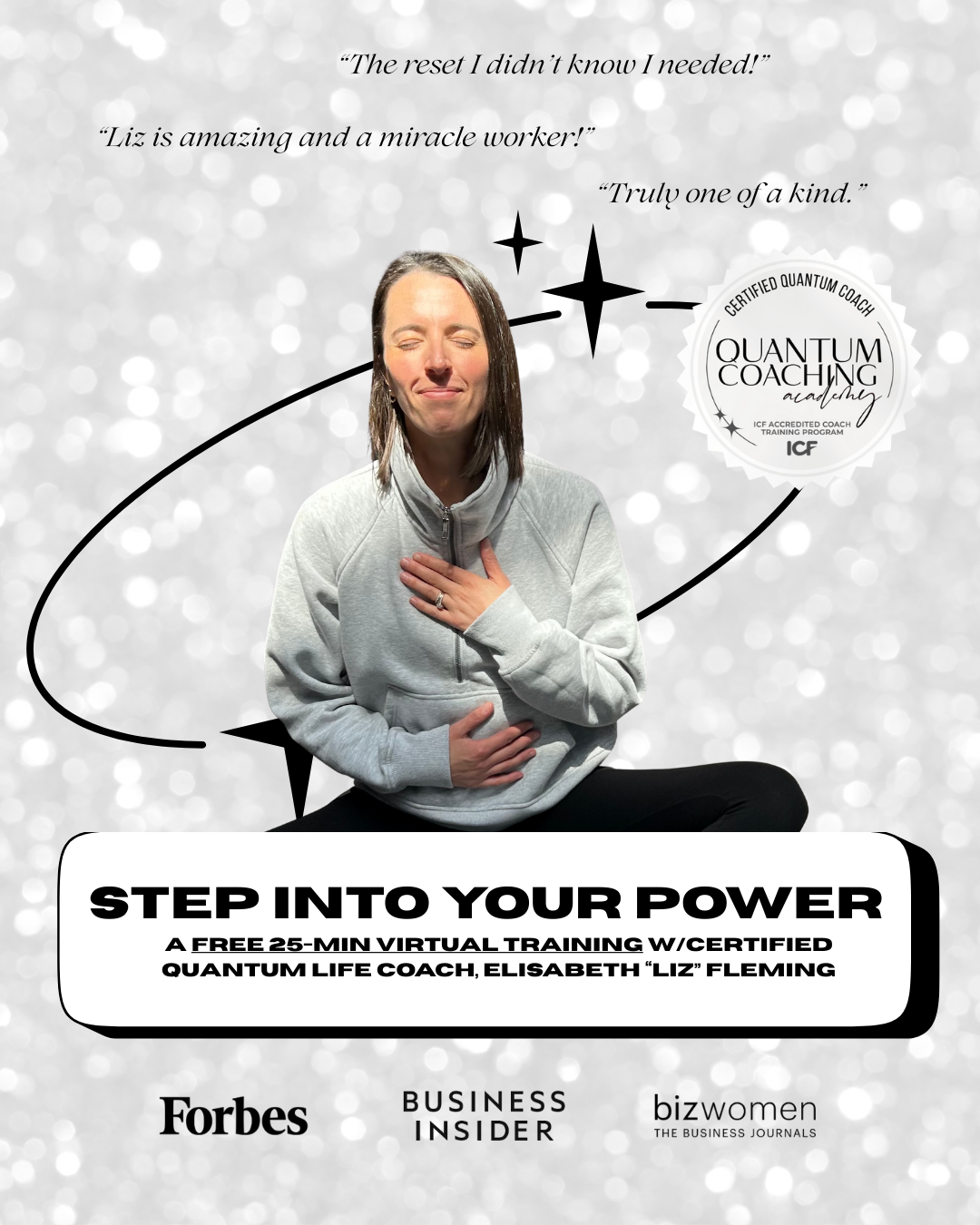
STEP INTO YOUR POWER
DISCLAIMER
The content and material presented on this podcast is for informational and educational purposes only. It shall not be construed as medical advice. The information and education provided are not intended or implied to supplement or replace professional medical treatment, advice, and/or diagnosis. The creator of this content does not dispense medical advice or prescribe the use of any technique as a form of treatment for physical, emotional, or medical problems without the advice of a physician, either directly or indirectly. The intent of the creator is only to offer experiential information to help the reader in his/her/their quest for emotional, physical, and spiritual well-being. In the event you apply any of the information provided from this content for yourself, the creator assumes no responsibility for your actions. Note: This post may include affiliate links! I may earn a small commission at no additional cost to you if you decide to click, sign up, or make a purchase.
