[20 MIN LISTEN]
As a certified quantum life coach for women, I’ve come to believe that learning how to regulate your nervous system is one of the most important life skills we can develop — not as a concept, but as a daily, embodied practice that supports emotional healing, self-trust, and sustainable growth.
Most women aren’t struggling because they’re doing something wrong. They’re overwhelmed because they’re holding more than one nervous system was designed to manage. Motherhood, partnership, work, caregiving, emotional labor, and personal growth all layered on top of one another create a level of internal activation that often goes unacknowledged.
When your nervous system is constantly in overdrive, it doesn’t matter how motivated or capable you are. Your body is simply responding to load.
How to Regulate Your Nervous System During Real-Life Stress
Nervous system dysregulation doesn’t always show up as panic or anxiety. Often it looks like irritability, numbness, exhaustion, resentment, brain fog, or the sense that you’re always one step away from snapping. Many women notice it during moments when they’re closest to rest. Nap time. Bedtime. Mealtime. The exact moments when peace feels just out of reach.
This isn’t a personal failure. It’s a biological response.
The nervous system’s job is to keep you safe. When too many demands stack up, it shifts into survival mode. Thoughts race. Emotions intensify. Small stressors feel enormous. Without regulation tools, it’s easy to spiral into negative narratives that make everything feel heavier than it actually is.
Regulation Is a Skill, Not a Personality Trait
One of the biggest myths in personal growth is that calm people are naturally calm. In reality, regulation is learned. It’s practiced. It’s built through awareness and repetition.
On days when everything feels like it’s happening at once, regulation might begin with something as simple as breath. Slow, steady breathing through the nose sends a signal of safety to the nervous system. From there, emotional release might come through tears, movement, or quiet solitude.
Regulation isn’t about stopping emotions. It’s about allowing them to move without letting them dominate your internal world.
Healing Isn’t Linear, and That’s Okay
Many women believe that once they’ve done enough inner work, they shouldn’t feel overwhelmed anymore. But healing doesn’t remove life’s challenges. It changes how you respond to them.
There will always be curveballs. Unexpected stressors. Full days that test your capacity. The goal of nervous system regulation isn’t to eliminate these moments. It’s to help you come back to yourself more quickly when they happen.
Growth often looks like catching the spiral sooner. Choosing a different internal narrative. Visualizing the best-case scenario instead of feeding fear. Trusting your intuition rather than forcing clarity through pressure.
Choosing Growth Over the Spiral
When the nervous system is overwhelmed, many women turn their frustration inward. They assume they’re failing at healing or attracting problems into their lives. In reality, emotional intensity often signals care, commitment, and love.
Learning to regulate means becoming the master of your emotional responses rather than letting them dictate your behavior. It means releasing projection and resentment and choosing grounded presence instead.
For many women, this shift comes when they stop waiting to be saved and realize they can create safety within themselves.
Why Nervous System Regulation Is Self-Love
Self-love isn’t just affirmations or self-care routines. It’s how you treat yourself in moments of stress. It’s whether you abandon yourself when things get hard or stay present with compassion.
Regulating your nervous system allows you to move through life with more ease, clarity, and trust. It supports emotional healing, embodiment, and confidence from the inside out.
This is the foundation of the work I guide women through as a quantum life coach and inside Self-Love Studio. When you learn how to regulate, you stop living in reaction mode and start making choices from alignment rather than survival. When you know how to regulate your nervous system, self-love stops being theoretical and starts becoming something you can access in the moments you need it most.
And that changes everything.
If you want a gentle place to go deeper and learn how to support your nervous system and self-trust, my free training Step Into Your Power is there for you.
Episode transcript:
This is an auto-generated, unedited episode transcript. Please excuse any tyops.
Welcome to The Life with Liz Podcast, the place to be if you wanna go from invisible to vibrant in your life and embrace the power you didn't know you had inside of you. I'm your host, Liz Fleming, business owner, mom, military spouse, entrepreneur, founder, CEO, and life coach, who is passionate about helping ambitious women like you step into their power and their purpose on purpose so they can experience as much joy, success, satisfaction, and abundance as humanly possible.
Now without further ado, let's dive right into this episode.
Hello, hello! Happy February. The season of love, or, as I like to think of it, the season of self-love.
I want to start today's episode by being really honest with you, as always. This conversation is coming straight from real life.
It's not from this perfectly calm, centered, regulated moment.
It's coming from a day where everything felt stacked.
The kids' routines, trying to care for myself, house projects, tax prep, a surprise vet visit for our elderly dog, and an injury I didn't see coming.
All of it happening at once.
Not just in one day, but in the span of an hour or two.
And I could feel it in my body, that familiar hum of overstimulation, the tight chest, the racing thoughts, that edge where you know if one more thing happens, you might lose your footing a little, you might lose your freaking mind.
This is the moment I want to talk to you about today.
It's not the ideal version of self-love.
Not the peaceful meditation montage with the crystals and the Palo Santo smoke.
The real moment where your nervous system is maxed the F out, and you're still expected to keep going.
Because if there's one thing I've learned, it's this: nervous system regulation is one of the most important life skills someone, especially a woman, can master.
And honestly, it might be the truest form of self-love there is.
So this February, when you're thinking about love, I want you to think about that internally. What that means for you.
As women, we hold so many roles at the same time. I talk about this in my book, Powerhouse.
We hold so many roles, right?
We're mother, partner, professional, caretaker, emotional anchor, problem solver, planner, fixer.
We make the meals. We manage the schedules. We smooth the family dynamics. We pursue our interests. And still try to show up as our best selves.
That's not one job. That's not one role. That's several nervous systems worth of responsibility.
So when you feel overwhelmed, overstimulated, short-tempered, numb, or completely disconnected, especially during seasons like this, or days like this, nothing has gone wrong.
Your body is responding to load.
Not failure. Not weakness. Load.
I had one of those days recently where I could feel myself starting to spiral.
The thoughts creeping in.
The urge to rush, to cling to the worst-case scenario, the tension building.
And instead of judging it or pushing through, I paused.
I paused long enough to notice what was happening in my body.
And that, in and of itself, for me personally, is just a huge milestone.
As someone who has gone through life with chronic anxiety and stress, and bouts of depression, the fact that I was in my awareness enough to pause.
And I say pause long enough, long enough is seconds worth, right?
To pause long enough to notice what was happening.
Just that awareness.
Having that awareness helped me so much.
Because it gave me a moment to say to myself, quietly but firmly:
I choose to have a good day. I trust that this will work out for my highest good. I choose. I choose and I trust.
And it wasn't because everything suddenly became easy.
But because I needed to interrupt the story my nervous system was trying to tell me, that false narrative of, oh my god, here goes, the dog's gonna die, I'm gonna have to put the dog down, I'm gonna have to do this, we're gonna get the money for that, and this isn't right, I gotta do this, I gotta do that, I also need to breathe, right?
That pause, in and of itself, it changed the entire trajectory of not just that moment, but my entire day.
It was phenomenal.
And I could feel in that moment, simply by shifting my thoughts, that the worry, the stress, it was dissipating.
That dark cloud was just kind of separating in the moment, right?
But here's what regulation continued to look like for me that day.
It wasn't pristine.
When I had that moment of pause, pausing long enough to know what was happening, it was from the drive between the vet office and home, when I was about to baw my eyes out, and scream, and just blah.
That was the span of a few minutes.
It wasn't pretty.
It wasn't this 30-minute ritual where I got on the ground and did a whole thing, like a seance.
It was me behind the steering wheel, focusing on my breath and regulating.
And we didn't get horrible news, right?
When the moments stack like that, it is load-bearing. It's intense.
We've all been there.
But regulation for me in that moment, those moments, looked like breathing.
It started with my breath.
A slow inhale through my nose for five seconds.
And a slow exhale through my nose for five seconds.
Again, and again, for a few minutes.
Just enough to signal to my body that I wasn't in danger.
Even though everything felt turbulent and urgent and the end of the world.
At school pickup, I'm gonna be honest with you, I cried.
I pulled in, and I was like, whoa, okay, I guess this is coming.
And it wasn't dramatic.
But I needed tissues to dab my eyes, and I just had a little moment.
And I let myself do that in front of my two-year-old daughter.
I just had the release.
And it was just enough to let some of the pressure release, instead of stuffing it down and suppressing it.
And that's what I felt called to do.
I knew in my body, it's gonna end up worse if I just try and shove this away in a locked box for later.
So I released a little of that pressure.
Little by little, I made it home with the kids, made it through lunchtime, the nap time routine, and when the house finally got quiet and I was alone with my pup.
I gave myself permission to sit alone, breathe, visualize, and process, and what that looked like initially was full-on sobbing, holding my dog, and just telling him how much I love him, and how thankful I am for him.
And it was what my body felt called to do.
Again, not that he's about to go over the Rainbow bridge, but something in me was like, I needed that moment of catharsis, that moment of just connection with this creature who's been with me through so much.
And in that moment of processing, I'm also processing other things that might have been hidden, right?
I'm coming up on the one-year milestone of losing my mother-in-law suddenly last year.
So I know for sure that there is some deep-rooted grief still making its way out, that maybe, consciously, in the moment, I'm not thinking about, but my body remembers.
My body remembers this time last year, and what it felt like.
So in that moment of stillness for me, I just let the emotions flow.
I let them flow and flow and flow.
I let them be what they needed to be without shame.
And that, my friends, is regulation.
It's not about stopping your emotions, or shoving them down, or suppressing them.
It's about letting them move through you without letting them take over your entire system.
Because that's when our bodies start to go into fight or flight, and then we get stuck in fight or flight, and everything's just heightened and intense.
You get the styes on your eye. You get the sores in your mouth. Your eye starts twitching for three months.
Regulation is the key to living well.
And allowing your body to grow and process what needs processing.
It's the most natural experience on the planet, in the universe.
And one of the biggest misconceptions about healing is that once you've done the work, you shouldn't get overwhelmed anymore.
That regulated people stay calm all the time.
That growth means smooth sailing.
That's not true, my friends.
The more that you grow, the more uncomfortable you're gonna be.
Because your body is living this new way of life, you're experiencing this new way of life, and even as you continue to grow and learn, life is always gonna throw you curveballs, kid.
You're gonna get sick.
Kids are gonna get sick.
Schedules will explode.
Plans will change.
Your nervous system will get activated again.
The difference isn't that it stops happening.
The difference is that you know how to come back to yourself faster and faster each time.
It helps for me to have an anchor.
And in that moment, I honestly felt so panicked.
I use my breath as an anchor.
But it's also helped me in the past to have a totem of some kind.
I almost always have a crystal on me, whether it's shoved into my bra, or my pocket, or my crossbody.
And I know that when I hold that, or my dad has these flat seashells in his pocket, the really smooth ones, and when he feels overwhelmed, he rubs it.
He calls it his chill shell.
Oh my gosh, isn't that adorable?
So, we all have chill shells.
He always gets us chill shells from the beach.
And I also have my crystals, which truly support me on my journey.
So if you ever want to chat crystals and chill shells, I'm your girl.
Anyway, my point is that regardless of what your totems are, having an anchor is so helpful in those moments where you just feel pure adrenaline, pure panic, and you start to fall into your black hole of depression.
I've been there.
I can say it, because I've been there.
I know how brutal and dreadful it feels.
And the more that you practice this, the more that you anchor yourself, whether it's with your breath or a totem, the more it's gonna get a lot easier for you.
The more often it's just gonna get so much easier.
You're gonna be like, oh, that's what it feels like for me to come down, for me to regulate.
It's so, so powerful.
And that regulation, it happens in waves.
Sometimes it's breath.
Sometimes it's tears.
Sometimes it's movement.
Sometimes it's solitude.
Sometimes it's simply stopping that spiral before it turns into a full-blown fake story about everything going wrong that hasn't even happened yet.
I've learned that a lot of what we experience as anxiety or overwhelm is actually the nervous system reacting to those false narratives.
Imagined worst-case scenarios, old conditioning, the pressure to be everything for everyone all the time without tending to ourselves.
When I catch that happening now in myself, I redirect.
And what's so awesome is that the more that I do that, the more that my family starts to do it as well.
And what really worked well for me yesterday, as I was processing all of this and going through the motions of processing, at the end, I was able to start visualizing the best-case scenario.
Instead of feeding the fear.
I got out my journal, and I was writing down the best-case scenario for everything.
And then I closed my eyes, I focused on my breath, I had my meditative music playing for a few minutes, and I just pictured getting the phone call from the radiologist that Griffin is just fine.
That, you know, still a big deal.
No big deal.
I've visualized every best-case scenario, and this is something that I've talked about before, too.
For a long time, I was the woe-is-me worst-case scenario girl.
And I would spiral, and I would spiral, and I would spiral, and I would project.
Until I decided I wanted to be the best-case scenario girl.
And it's much more fun to live life that way.
And that doesn't mean you can avoid every bad thing that's going to happen to you, but you can choose to see those challenges as growth.
And when you picture the best-case scenario for every moment, it is its own form of regulation and healing.
And I remind myself that I can trust my intuition in that way, and that I don't need to rush my way into safety.
But it does help to visualize.
The beauty of the best-case scenario.
Here's a reframe that changed everything for me.
When my nervous system is overwhelmed, it doesn't mean I'm failing at life, or manifesting something wrong.
I want to make that really clear for you, too.
It usually means I care deeply.
I love deeply.
I'm invested.
So when you feel deeply, I want you to stop seeing it as a form of a flaw, or a punishment.
Your ability to love and care and feel so deeply, your sensitivity, is a superpower.
It means that you get to have that feeling.
You know what love is, in some shape or form.
And that is such a gift.
The feelings aren't the flaw.
They're information.
The work is learning how to be the master of my emotional responses, instead of letting them eat me alive.
I used to project.
I used to snap.
I used to carry resentment fueled by exhaustion everywhere I went.
And at some point, I realized I was waiting to be saved from a life I actually had the power to regulate myself.
And things got easier when I put down the sword.
Things got easier for me when I put down the sword, when I stopped bracing for impact and allowed myself to be fluid.
When I trusted my own pace.
Instead of policing my personality and judging every misstep.
In coaching, we call that the big dick energy, the deepest inner critic.
So when I put that down, then I stepped back, and I let myself feel.
Everything changed.
Self-love for me became less about doing more and more and more and more.
And more about responding differently.
This is why I believe nervous system regulation is the ultimate form of self-love.
It is so badass when you love yourself.
It is the most valuable life skill that you can have.
While you are here, a beautiful soul, incarnated in a human body, here on planet Earth.
That is the ultimate gift you can give yourself, is self-love, self-trust.
It's how you show yourself that you care in the moment.
You're showing yourself a form of care.
You're not likely to abandon yourself from.
It's how you stay with your life instead of checking out from it.
It's how you move through challenges without making them mean something is wrong with you.
And this is the kind of work I guide women through as a coach, especially in my program and community, the Self-Love Studio, and it all starts in my free training, Step Into Your Power.
It's not to create this movie style life, right?
But to help you feel safer inside the one you already have.
The beautiful life you already have.
Because when you regulate your nervous system, you stop living in reaction mode.
You create space for intuition, clarity, and grounded decision-making.
And that changes everything.
So if you're listening to this, and you're thinking, yeah.
Yeah, girl.
That sounds like me.
I want you to know, first of all, hi, hello.
Nice to be on this journey with you.
But I want you to know, you're not behind.
And you are absolutely not broken.
You don't need fixing.
You're responding to a full life.
Regulation doesn't mean life stops being hard.
It means you stop facing it alone, inside your own body.
This month, instead of pressuring yourself to do more, consider this a different invitation.
Show yourself some love.
By learning how to regulate your nervous system in the moments when you need it most.
Listen deeply.
I'm so glad you're here.
And I'll see you next time.
Did that go by too fast? No worries. You can always find me over at elisabethfleming.com for more information about my programs, events, and how you can take your learning further with me. If you loved this episode, leave a review. It helps more than you know.
Thank you so much for tuning in. I'll catch you next time.
Connect with Liz:
Watch Liz's FREE Workshop, Step Into Your Power:
Discover the 3 hidden patterns draining your energy and learn how to start feeling like yourself again. Watch now at elisabethfleming.com/free-workshop
Read Liz's Book:
Discover Liz’s bestselling book, Powerhouse: 3 Steps to Thrive as the Incredible Woman You Already Are — A Framework for Self-Love and Expansion: elisabethfleming.com/book
Resources:
Website: elisabethfleming.com/welcome
Instagram: @mslizfleming
Podcast: The Life with Liz Podcast
If you loved this episode, rate and review it to help reach the women who need it most!
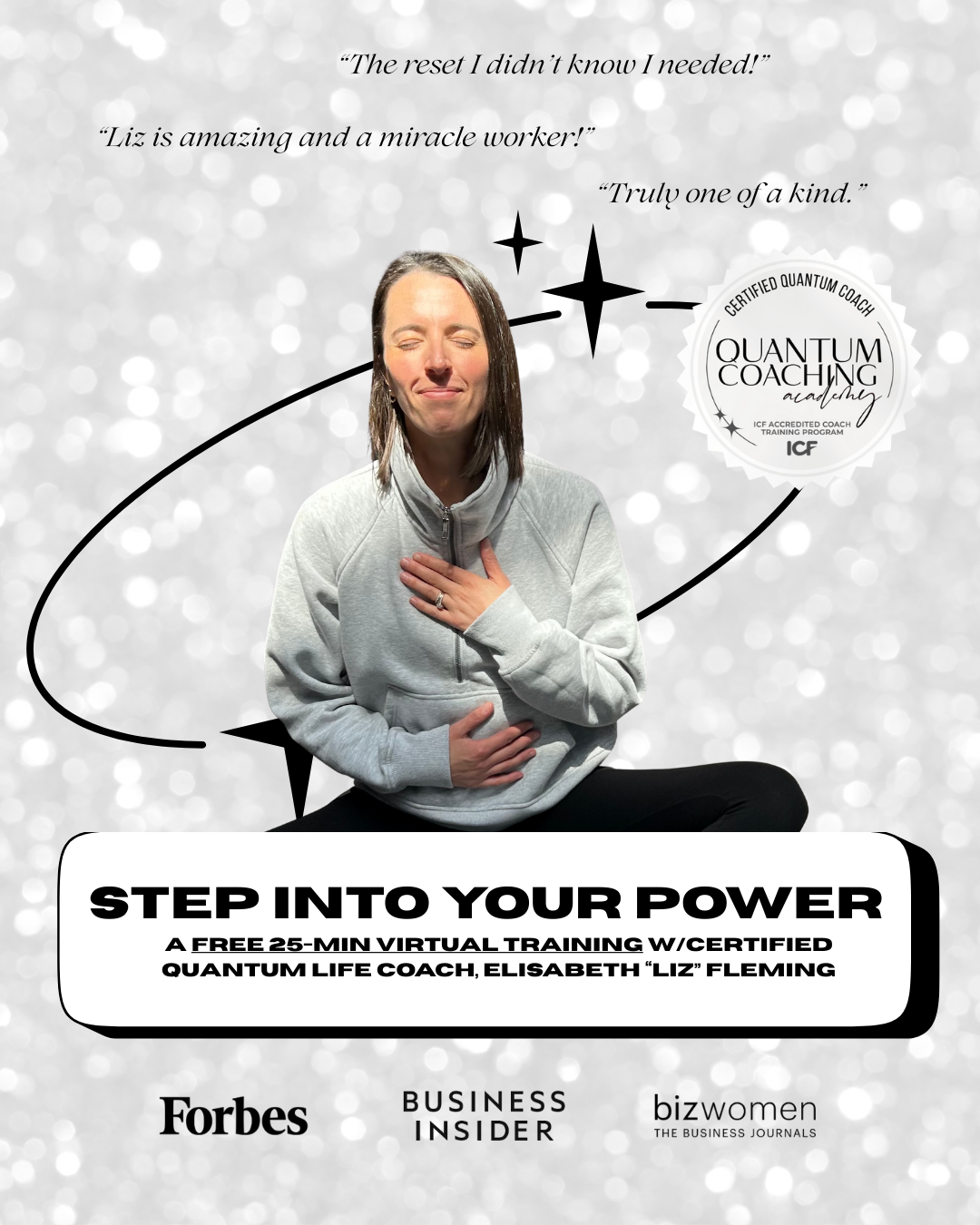
STEP INTO YOUR POWER
DISCLAIMER
The content and material presented on this podcast is for informational and educational purposes only. It shall not be construed as medical advice. The information and education provided are not intended or implied to supplement or replace professional medical treatment, advice, and/or diagnosis. The creator of this content does not dispense medical advice or prescribe the use of any technique as a form of treatment for physical, emotional, or medical problems without the advice of a physician, either directly or indirectly. The intent of the creator is only to offer experiential information to help the reader in his/her/their quest for emotional, physical, and spiritual well-being. In the event you apply any of the information provided from this content for yourself, the creator assumes no responsibility for your actions. Note: This post may include affiliate links! I may earn a small commission at no additional cost to you if you decide to click, sign up, or make a purchase.
